
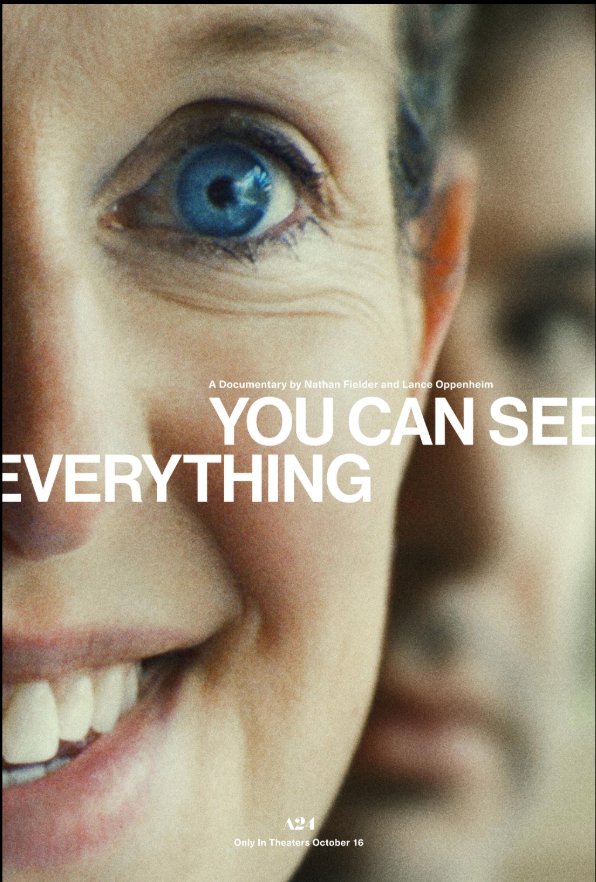
On the surface, You Can See Everything seems like a true-crime slog that clocks in at almost three hours. Creepy? That could be inferred. Slanted? I hoped not given that this is a documentary, but let’s remember the times we live in. THREE HOURS worth of material? Yikes.
Here’s the good news: all of it is TOTALLY worth it.
Lance Oppenheim (who already has an insanely good film this year with Primetime) co-directs with Nathan Fielder (who has concentrated on television with projects like The Rehearsal) in the story of Theranos founder Elizabeth Holmes and her partner, Billy Evans, as she prepares to serve her just-over eleven year sentence for three counts of wire fraud and one count of conspiracy to commit wire fraud. Starting in late April of 2023, Fielder winds up living on the rental property they have on the San Diego coast as he documents their life with their two kids in the final month before Holmes is to report to federal prison in Texas. Initially resistant to be that geographically close to them, he gives in as the story of who they are versus who the public sees (including Hulu’s The Dropout) becomes more and more intriguing.
And that’s all I have to say about that.
Now, you may be reading this and thinking, “but Rob, this thing goes Stupid Boat Movie length… how intriguing can this be”. Oh, not so fast my friend.
This is actually a story of two movies, but to talk about what happens in the second half would be a spoiler that I am not even giving to people who ask in person; it’s THAT nuts. In the first half, I wondered about Fielder being on-camera as a director is not traditionally involved this deeply and intimately in the subject of their films. He seems to be the proverbial stick to the bear that is trying to get Holmes to talk deeper about what happened with Theranos and finds himself dealing with a family that dances around it until it is apparent that they must show him what the intent was versus what was portrayed in the court of public opinion (and eventually the courts). I even got to the point where my note was “if you like extreme closeups and slow zooms, this is the movie for you” to find something to keep me engaged as the dog chased its tail leading up to her days checking into the facility in Bryan, Texas. At the one-hour mark, my brain hurt as I was trying to put all of the pieces together, and as been inferred earlier, that is at the halfway point.
Acts two and three of this film is where the reasoning for Fielder’s presence all comes together. Again, I am doing my best not to spoil anything so that as the directors said in pre-recorded opening remarks “others can enjoy the experience (we) did” because where this goes deserves to be seen the same way I did: completely cold. It is rare for a documentary director to have a character arc, but as the kids say, “here we are”. I have to imagine that even seeing the completed film for the first time affected him over and over again infinitely more that it affected me as an audience member, and I found myself shaking my head, facepalming, and even “WTH”-ing more times than I care to count.
I honestly could go on for days about this film and how it went from mediocre to “OMG,” but this is three hours that must be seen to be truly understood. Although the old saying goes that we are all the hero of our own stories, You Can See Everything does exactly what a documentary is supposed to do: ask more questions that it answers. Holy COW.